How to Write a Cover Letter: Four Paragraphs, 300 Words
Summary
How to write a cover letter: open with the role and one specific reason you want it, prove fit with a single result that has a number, add one detail about the company, and close with a plain next step. Keep it to 250 to 350 words and address a named person. Use templates for the frame and AI for structure, but write the first sentence yourself, because that is the line a tired reader decides on.
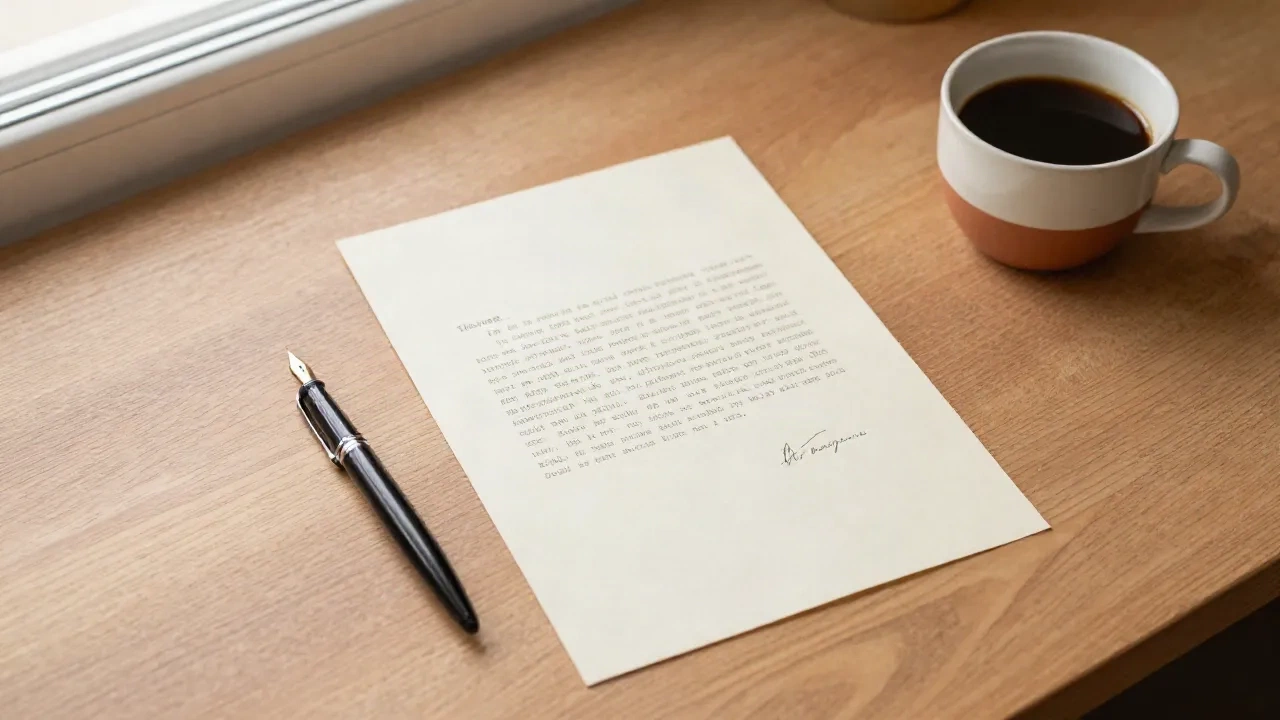
How to write a cover letter comes down to one decision: say why this role and this company in the first two sentences, then prove it with one or two specific results. Keep it to about 300 words, address a named person where you can, and stop before you start repeating your CV. Everything below is the detail behind that sentence, from someone who reads these letters for a living.
Why most cover letters lose the reader by line three
I read cover letters for mid-market tech roles, and the pattern is consistent. The first line announces that the writer is applying. The second line says they are passionate. By the third line I know nothing I could not have read in the job title.
The reader is not hostile. They are tired, they have forty more of these, and they are looking for a reason to keep going. A Resume Genius survey of 625 US hiring managers, run in 2022, found that 83 percent read cover letters at least frequently. So the letter is read. It is just read fast.
That changes the job. You are not writing a formal introduction. You are writing the shortest possible argument that a conversation with you is worth an hour of someone's week.

What goes in the four paragraphs
Four short paragraphs cover almost every application. Here is what each one does.
Paragraph one, the reason. The role, where you saw it, and the single most relevant thing about you. Two or three sentences.
Paragraph two, the proof. One result, with a number or a named outcome. Written as what happened, not as a trait.
Paragraph three, the fit. Something specific about the company that you could not say about its competitor. A product decision, a hiring pattern, a recent launch.
Paragraph four, the close. What you would like to happen next. One sentence, plain.
The UK National Careers Service guidance says much the same: short, tailored, and addressed to a named person. When two unrelated institutions agree on a format, it is usually because the format works.
Notice what is missing. There is no paragraph that restates your work history in prose, and no paragraph about your values. The CV exists for the first. The interview exists for the second.
The first sentence decides the rest
Compare two openings for the same product marketing role.
The usual one: "I am writing to express my interest in the Product Marketing Manager position at Northgate."
The one that gets a second read: "Northgate's move from per-seat to usage pricing last spring is the reason I am applying for the Product Marketing Manager role, because I wrote the launch plan for the same change at my current company."
The second opening is longer and it works harder. It names the role, shows you did your reading, and offers a credential, all before the first full stop. A reader who sees that will usually read the next paragraph out of curiosity alone.
A simple test: cover the company name. If the sentence still makes sense for any other employer, it is too general. Rewrite it until it would not.
How long, and what to cut
Aim for 250 to 350 words. In a ResumeLab survey of 205 HR professionals, 42 percent preferred a letter between half a page and one page, and 40 percent preferred less than half a page. Only 18 percent wanted more. Resume Genius found a preferred length near 400 words. The two sources point at the same range: under one page, closer to half.
When a draft runs long, cut in this order.
Any sentence that starts with "I believe" or "I feel". State the thing instead.
Adjectives you chose for yourself. Hardworking, dynamic and detail-oriented tell the reader nothing, because everyone writes them.
The paragraph that summarises your CV. If it is also in the CV, it is a duplicate.
The apology for the gap, the career change or the missing requirement. Address it in one clause or not at all.
What remains is usually better than what you started with. Cutting is the part of the job that feels like losing, and it is the part that does the most.
When rewriting kills tone
There is a trap in the second draft. You polish for an hour, every sentence becomes correct, and the letter stops sounding like a person. I have seen this in the letters that come through my inbox after a candidate has run the text through a grammar tool, then a rewriting tool, then asked a friend.
Correct is not the goal. Recognisable is. The reader should be able to imagine the voice in a meeting.
Three habits help.
Read the letter aloud. Anything you would not say to a colleague over coffee gets rewritten.
Keep one sentence that is slightly unlike the rest, a short opinion or a mild joke. It is the proof that a person wrote this.
Make your edits in a single pass, then stop. Every extra pass moves the text towards the average.
If you use a checker, use it for typos and for sentences that run past thirty words. Do not accept every tone suggestion. The tool does not know the reader.

Using AI and a keyword scanner without losing the letter
Most candidates now draft with an assistant, and most recruiters can tell. The giveaways are consistent: a first line that praises the company's mission, a middle that lists three virtues, and a close that thanks the reader for their time and consideration. None of it is wrong. All of it is interchangeable.
The workable approach is to let the tool fill structure and keep the specifics yours. Give it the four-paragraph outline above, paste in your real result with its number, and ask for a draft that stays under 300 words. Then rewrite the first sentence by hand. The boilerplate disappears. The personal part stays yours.
Two cautions. First, never let a tool invent a result or a detail about the employer. A made-up product launch in a letter is the quickest way to lose a candidate I was otherwise keen on. Second, a keyword scanner is a different tool from a writing tool. Jobscan, for instance, compares your letter against the pasted job description and returns a match rate, and it suggests edits to a draft you already have. It does not write one. That is a sensible division of labour: you write, it checks coverage.
Skip the scanner entirely if you are applying to a small company where a person reads every application. Matching keywords helps with software filters, not with the founder who has your letter open next to a coffee.
Templates: yes, but only for the frame
A template is fine. A template that you fill with company names is not. The difference is how much of the letter is a slot and how much is a sentence.
Use the template for the parts that never change: your contact block, the layout, the sign-off, the length ceiling. Write the opening and the fit paragraph from scratch every time. That is about ten minutes of real writing per application, and it is the ten minutes that matters.
If you want a ready-made layout to start from, a resume builder with cover letter templates will save you the formatting. Kickresume, for example, offers four cover letter templates on its free plan, which is plenty for a plain one-page layout. Pick the plainest option and delete the decoration.
For senders applying to many roles, keep a short file of results you can draw on, each written in one sentence with its number. Assembling a letter from three of those, then rewriting the opening, takes minutes and still reads as written for this role.

Salutation, sign-off and the small things
These details are minor and they are also where careless letters show.
Find a name. Check the job post, the company page and the hiring manager's profile. If you truly cannot find one, "Dear Hiring Manager" is acceptable.
Match the sign-off to the greeting. In British usage, "Yours sincerely" follows a name and "Yours faithfully" follows "Dear Sir or Madam". In the US, "Best regards" or "Sincerely" both pass.
Send it as the email body or a PDF, not both. Pick one and say nothing about the other.
Name the file properly. "FirstName-LastName-cover-letter.pdf" beats "Cover letter final v3".
Proofread the company name last. Copying a letter between applications and leaving the previous employer's name in the second paragraph is the most common fatal error I see.
When to skip the cover letter
If the application form marks the letter as optional and gives you a free-text box, still write three sentences. If there is no field for it, do not email one separately. If the posting says no cover letters, believe it.
There is one more case. When you know someone at the company, a short, direct message to that person often does more than a formal letter submitted through a portal. Use both when you can. Treat the letter as the version that sits in the file, and the message as the version that gets read first.
What to do with your next draft
Before you send, check four things. The first sentence could not belong to another company. There is one result with a number in it. The length is under 350 words. A named person is in the greeting, or you have a reason for not having one.
Then close the document and send it. A letter that is good and sent beats a letter that is perfect and still open on Sunday night. The click to Send is always yours, and so is the opening sentence that made the reader keep going.